





|
GCAL CUT GRADING
In this section:
GCAL CUT GRADING
Direct Assessment Light Performance
Diamonds are treasures from the Earth and color and clarity are natural
phenomena, but cut is solely the result of the skill and artisanship of the
cutter. Master craftsmen reveal the hidden beauty of diamonds in the rough. A
well cut diamond is brilliant regardless of color and clarity.
How much a diamond reflects, refracts and releases its inner beauty is
determined by how well it plays with light – its brilliance and symmetry. GCAL
measures, captures and records each diamond’s individual light performance
through direct assessment analysis.
There are many ways to assess if a diamond is well cut. For many years, the
cut quality was judged by proportions, such as depth percentage and table
percentage, but this system was based on 2-dimensional mathematics. In the early
1990s, diamantaires began discussing a need for a cut grading system more in
agreement with the way diamonds actually appear to the eye.
The most true-to-life method that developed is Direct Assessment Light
Performance analysis. This method analyzes the actual diamond and not a model,
which means every nuance, such as inclusions and transparency, are considered.
In 1996, the Diamond Profile Laboratory was the first lab to illustrate and
grade light performance. Diamond Profile Laboratory and its direct assessment
technology were purchased in 2003 by GCAL laboratory. GCAL continues to use this
proven and copyrighted technology to grade and evaluate light performance. Light
Performance is analyzed in two categories, Optical Brilliance and Optical
Symmetry.
Optical Brilliance Analysis
GCAL directly assesses the overall return of light to the viewer, called
‘brilliance’.
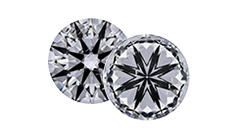
The Optical Brilliance image is actually a digital photograph of the diamond
taken in a special lighting environment that creates a strong contrast between
the bright and dark areas. The image is then processed in a proprietary computer
program that calculates the percentage of brilliance and the amount of light
loss. This is a scientifically accurate and repeatable way to measure
brilliance. The light gray areas of the image are facet outlines resulting from
image processing to provide a realistic representation of the diamond’s unique
faceting.
In the Optical Brilliance Analysis image on the certificate, the white
represents the light return and the blue represents areas of light loss. The
light return is quantified based on measurable light return (aka – performance)
and then graded as: Excellent, Very Good, Good, Fair or Poor.
Since the Optical Brilliance is measured by direct assessment, meaning that
it is judged based on the way each diamond actually performs rather than a
theoretical model, the brilliance image of each individual diamond will always
look slightly different.
You can explain to your customer that brilliance is what gives a diamond its
life, and what makes a diamond shine from across a room. Diamonds with a low
percentage of brilliance look dull and dark. You can demonstrate to your
customer how their diamond compares to other grades by showing them the scale on
the cover panel of the certificate.
 
Optical Symmetry Analysis
Symmetry is the beauty and organization of everything in nature, science and
art. Aesthetically pleasing proportions and balance represent perfection.
Patterns repeated in radial or reflective symmetry have harmony. The symmetry of
a diamond’s facets is in fact artwork created by the master craftsman who cut
the diamond.
The Optical Symmetry Analysis image is a digital photograph taken of each
diamond in a special lighting environment that reveals the patterns of light
return. All light returned at the same angles is represented by the same color.
For example, all red areas represent light being returned within a consistent
angle range. Therefore, the Optical Symmetry assesses the consistency of angles
and alignment of facets by looking at the equality of light return.
Since the Optical Symmetry is measured by direct assessment, meaning that it
is judged based on the way each diamond actually performs rather than a
theoretical model, the symmetry images of each individual diamond will always
look slightly different. Like the beauty and ever changing color patterns in a
kaleidoscope, each diamond reveals its unique reflective pattern of symmetry.
You can simply explain the quality of the cut by showing your customer the
symmetry image–the more even the pattern, the better the symmetry.
 
The GCAL Round Brilliant Cut Grade System
The GCAL Cut Grade encompasses ten factors to determine a diamond’s light handling ability.
These factors are separated into the categories of Light Performance, Finish and Proportions.
The sum of these categories equals the total Cut Grade, with Ideal (100) being the highest possible grade.
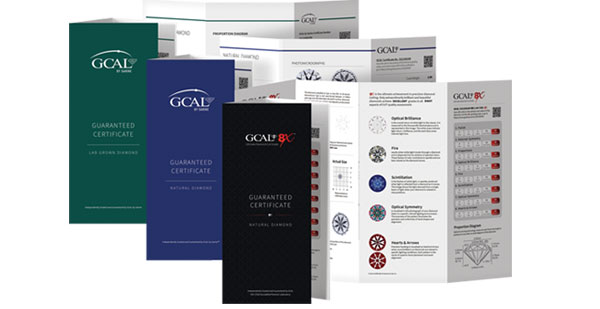
Click here to view the Cut Grade Brochure (PDF format)
Grading Polish
‘Polish’ describes the quality of the facet surfaces and is related to the
luster of a diamond. It can also be described as how free a diamond is from
scratches. A high quality polish requires the diamond cutter to pay meticulous
attention to the final stages of cutting.
Polish is graded as: Poor, Fair, Good, Very Good and Excellent. The majority of
diamonds manufactured by modern cutting technology have at least Good polish.
When judging a diamond’s polish quality, graders tend to start off with the
grade of ‘Good’ in their mind and then look for reasons to grade ‘Very Good’,
‘Excellent’ or ‘Fair’; but this is not the correct mentality. It is better to
start off thinking ‘Excellent’ and then find specific reasons to justify a lower
grade. Remember, the diamond is innocent until proven guilty.
Each polish grade has a range. Here are examples of what you can expect to
find for each grade:
• Excellent: minor areas of facets with some light polish features
• Very Good: light polish lines on several facets
• Good: burnt facets, numerous facets with transparent or white polish lines,
numerous abrasions, at least one full facet of moderate polish lines
• Fair: many facets that appear frosted due to heavy burns or many with very
heavy white and transparent lines that can give the diamond either a cloudy look
or a heat wave look.
• Poor polish is rare but occurs when the overall diamond is difficult to see
through numerous facets and is very visible to the unaided eye
Grading External Symmetry
External Symmetry is a physical quality grade judged by a gemologist
examining the exterior of a diamond under a microscope. It assesses the shape
and alignment of facets. External Symmetry is graded as: Poor, Fair, Good, Very
Good and Excellent.
This should not be confused with Optical Symmetry, which is a grade of how
well the diamond handles light as judged through digital imaging. It assesses
the consistency of angles and alignment of facets by looking at the equality of
light return.
As with judging a diamond’s polish, when judging a diamond’s external
symmetry graders tend to start off with the grade of ‘Good’ in their mind and
then look for reasons to grade ‘Very Good’, ‘Excellent’ or ‘Fair’; but this is
not the correct mentality. It is better to start off thinking ‘Excellent’ and
then find specific reasons to justify a lower grade. Remember, the diamond is
innocent until proven guilty.
Here are some things to look for when grading a diamond’s external symmetry:
• When judging round brilliant cuts,
start by checking the overall symmetry of the diamond by placing the diamond in
the iris diaphragm and slowly rotating it while looking at the roundness of the
outline, the perfectness of the octagonal table and centering of the culet.
Then, look for the alignment of pavilion mains to crown bezels, look for open or
short facets, compare the widths of the pavilion mains, and compare the shapes
of the bezel facets.
• When grading fancy shapes, give them some
leniency compared to round brilliants. Focus on judging the symmetry and not the
aesthetic shape. Check the symmetry of the outline and then look for the
alignment of pavilion mains to crown bezels, look for open or short facets,
compare the widths of the pavilion mains, and compare the shapes of the bezel
facets.
Judging Girdle Thickness
The widest part of a diamond, between the crown (top) and pavilion (bottom)
is called the ‘girdle’. The thickness of the girdle is assessed as a range and
described as: Extremely Thin, Very Thin, Thin, Medium, Slightly Thick, Thick,
Very Thick, and Extremely Thick.
Many graders are uncertain about assessing girdle thickness. Girdle thickness
is important because it is part of the overall proportion grade and it is a
factor in weight estimation of mounted diamonds. Here are a few pointers:
• When judging brilliant cuts, measure the
concave areas (aka the valleys) of the girdle rather than from peak to peak.
• Square and rectangular cut are measured
around the entire girdle, including the points. If the corners are missing the
facet edge and come to a point, this is considered Extremely Thin.
• Do not measure the cleft area of heart
shapes, as this will always be extremely thick.
• If you are going to directly measure the
girdle in millimeters, remember that the measurement in mm is proportional to
the size of the diamond. For reference a medium girdle for a 1.00 carat diamond
usually measures about 0.10mm. This image shows a magnified millimeter gauge and
the girdle descriptions for approximate millimeter thicknesses for a 1.00 carat
round brilliant cut diamond.

Video: Watch How Optical Light Performance is Analyzed at GCAL
Video: Watch How Diamonds are Measured at GCAL
FREQUENTLY ASKED QUESTIONS
What is Cut?
Cut is a word with two meanings.
The first meaning of Cut refers to the Shape of a stone - round, oval, rectangular, marquise, pear, or heart.
The second and more important meaning of Cut involves aspects of craftsmanship, including dimensions, proportions,
angles, symmetry, faceting and polish.

I've heard that Cut is the most important of the 4C's... is this true?
Many experts have differing views on this, and the only safe answer might
sound like a copout. While cut may be the most important of the 4Cs to reveal
the overall inner beauty of a diamond, you don’t want to sacrifice color and
clarity to the extent that they aren’t equally important. When your budget
allows for very good color and no visible inclusions to the naked eye, then by
all means go for the best cut and sacrifice weight (size) if necessary. It’s a
worthwhile tradeoff. Here’s why…
A diamond is the ultimate light-handling machine. A well Cut diamond is a
masterpiece of optics designed to return light to its owner's— or admirer's eye.
To unleash maximum brilliance, fire and sparkle, a diamond must be manufactured
with the same expert skill and precision as a fine automobile. This means
Cutting is as much the key to diamond performance as engineering is the key to
car performance.
Think of diamond buying as, in part, like taking a gem for a test-drive. Just as
you base a car purchase on a vehicle's physical performance, you base your
diamond purchase on its visual performance.
Is there a standard diamond Cut?
The most popular and 'standard' diamond shape is the round brilliant. The
round brilliant is designed to maximize the light performance of a diamond.
After years of extensive study, the modern round brilliant has evolved to have a
narrow range of acceptable proportions that maximize the optical potential of a
diamond and produce the best combination of brilliance, fire and sparkle.
An 'Ideal Cut' is the highest standard. A diamond that achieves Excellent
ratings in the categories of Light Performance (optical brilliance and optical
symmetry), Finish (polish and external symmetry) and Proportions (table size,
depth %, crown angle, pavilion angle and girdle thickness) is considered an
'Ideal Cut'.
How many facets does a diamond have?
It depends on the shape and cutting style. A standard round brilliant has 57 or
58 facets, an emerald step has 49 or 50 facets, a princess has 53 facets, etc.
Some shapes have over 100 facets, but more facets do not necessarily equal
more brilliance, it just means that the light is broken up into more rays and
reflected in more directions.
Even tiny diamonds, as small as 1-point (0.01ct), are commonly faceted as
round brilliants with 57 facets.
What are the different parts of the diamond?
The main parts of a diamond are:
Table
Crown
Girdle
Pavilion
Culet

How do I know if a diamond is a good Cut?
The abridged answers...
• Look and see for yourself.
• Buy a diamond that you think is beautiful.
• Buy a diamond that you fall in love with.
• Ask for a diamond with a GCAL 'Ideal Cut' certificate.
The unabridged answer...
Grading every aspect of cut quality falls into three categories –
proportions, finish and overall craftsmanship.
Proportions = Light Return
Diamonds are cut to exact proportions that have evolved over the last hundred
years of study. The interrelationship between these proportions— table size,
crown angle, pavilion angle, girdle thickness, and culet size— determine how
much light that enters the diamond is returned to the observer's eye in
sufficient strength to give the stone full beauty and vitality. This is called
light return.
Light return, which is determined by proportions, is described as:
• Brilliance (the overall brightness and light returned to a viewer's eye)
• Fire (dispersive colored light like rainbows from a prism)
• Scintillation (the sparkle you see when a diamond moves)
Because proportions directly influence light return, some people assess cut
quality based on proportions alone. They measure parts of the diamond and then
either: (1.) determine which grade range the proportions fall within on standard
measurement grading charts, or (2.) rely on software to make a digital model of
the diamond that tries to predict what the diamond looks like.
Judging cut based on two-dimensional mathematics or theoretical modeling is
not the best way to evaluate light performance because it doesn't take into
account slight nuances of faceting, shape, and clarity features.
The best way to judge cut quality is to analyze the actual light return
coming from the real diamond. This is how GCAL's proprietary direct assessment
light performance technology works. We photograph the diamond in an environment
that clearly distinguishes where light 'leaks' out the bottom of the diamond.
Then we scientifically calculate the percentage of light leakage versus light
return.
On every GCAL certificate, the Optical Brilliance image allows you to see for
yourself exactly how much light is coming from the diamond. The dark blue areas
are the light leakage and the white areas are the light return. This is the
simplest way to know that your diamond is well cut and has good proportions - no
need to worry about numbers, angles and percentages.
Craftsmanship = Symmetry
Craftsmanship is a judgment of the diamond cutter's workmanship. When a
diamond cutter transforms a diamond-in-the-rough into a beautiful gemstone, they
first must properly proportion all the angles, and then they must finish each
facet with skill, patience and artistry. This is graded as polish and symmetry.
Polish refers to the final finish of each facet. If the diamond's surface is
microscopically smooth and free of scratches then it gets an excellent rating.
The more scuffs, the less the rating.
Symmetry is an assessment of each facet's precise shape, placement, and
alignment. Symmetry is graded in two ways:
1. External Symmetry assesses the physical symmetry of each facet and is graded
by examining the diamond under 10x magnification.
2. Optical Symmetry assesses the consistency of angles and alignment of facets
by looking at the equality of light return. This is graded by placing the
diamond in an optical symmetry reader that reveals the patterns of light return.
The Optical Symmetry image on every GCAL certificate is a photograph of the
diamond captured while in the optical symmetry reader.
You can see the quality of the cut by looking at the Optical Symmetry image
on your GCAL certificate - the more even the pattern, the better the symmetry.
All light returned at the same angles is represented by the same color. For
example, red areas represent light being returned within a consistent angle
range, green areas represent a different angle range, etc.
How does cut affect value?
Skilled craftsmanship, precision, patience.
These are required to make brilliant, symmetrical, well Cut diamonds, and
such artistry has a price. All other quality factors being equal, excellent Cut
diamonds cost about 20-30% more than average Cut diamonds. However, it's easy to
argue that a well Cut diamond is at least 20-30% more beautiful than an average
Cut, even if the color and clarity are lower qualities.
A well Cut diamond is properly proportioned and precisely faceted. Proper
proportions mean the diamond will reflect back the most amount of light to the
viewer. This is known as brilliance. If the diamond is cut too shallow or too
deep then the light will leak out the bottom. Precisely aligned facets mean the
diamond produces a beautiful, even, balanced sparkle. This is known as symmetry.
How does shape affect value?
Don't confuse Shape & Cut – they are not the same thing. Shape refers to the
outline of a diamond, such as Round, Heart, or Square (aka Princess) and Cut
refers to the quality of faceting.
The shape of a diamond affects the value because some shapes inherently yield
a better weight retention percentage from the rough material. In other words,
some shapes more closely follow the natural rough diamond form and therefore
don't waste as much material during the cutting process. Faceted diamonds
typically weigh 40%-60% of their original rough weight.
Supply and demand also play a part in how shape affects the value of a
diamond. Rounds are the most popular and most costly shape. In addition, round
brilliants require the most amount of skill and time to cut properly.
Generally speaking, when comparing diamonds of equal size and quality, rounds
are the most expensive shape followed by Heart, Asscher, Pear, Oval & Marquise
and then Emerald, Radiant, Cushion & Princess.
The price difference between rounds and princesses can be as little as 0-20%
in lower colors and clarities, and as great as 100% in larger sizes and higher
colors and clarities.
|